Blog 8 July 2026
What is Africa’s air quality data gap?
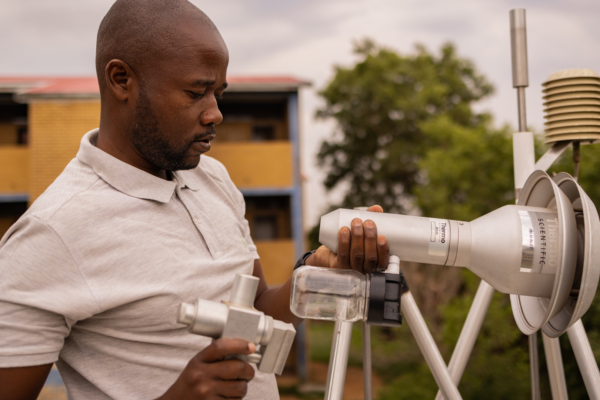
Many African cities lack the systems and tools to monitor and manage air quality effectively. A recent review of a global database of on-the-ground air quality monitoring stations found that less than 4% are located in Africa or South America. Africa has fewer than 1,500 active continuous air quality monitoring locations, highlighting both limited data availability and constrained opportunities to generate trusted, locally relevant air quality data.
Low-cost sensors have helped cities understand their air quality and expand access to data for the public. However, many African cities lack the technical capacity to fully benefit from these sensors. The lack of access to high-grade reference stations is a barrier to scaling up low-cost sensor networks, as these stations are critical for calibrating the accuracy of low-cost sensors.
While scientific research and the application of low-cost sensors have grown rapidly over the past decade, most of these applications and case studies originate from the Global North. These learnings cannot be easily applied to deploying low-cost sensors in Africa, as it differs significantly in terms of climate conditions, pollution sources and infrastructure.
Setting up a long-term monitoring programme is more complicated than simply choosing which sensor to use. Network managers need access to robust methodologies and tools for effectively managing their sensor networks, but these resources are usually not readily available.
Building the tools African cities need to act
AirQo is bridging the data gap through localised resources for managing low-cost sensor networks across Africa, based on our experience deploying and managing hyperlocal sensor networks across 14 cities. The initiative is supporting network managers and city authorities across Africa with AI-powered, open-source tools for improving how data is measured and used.
We are scaling up the deployment of open-source tools and geospatial modelling to support network development, sensor calibration and improved access to air quality data. We are starting in Kampala, Uganda, and Nairobi, Kenya, which will help us ultimately provide a methodological framework for tackling the core barriers to low-cost sensor adoption for long-term monitoring across the continent.
Sensor data in cities like Nairobi and Kampala is providing timely, granular information on air quality across specific locations, which was not previously possible.
“Nairobi is already making significant progress using a hybrid network consisting of two reference-grade stations and over 50 low-cost sensors to monitor air quality across its neighbourhoods,” says Maurice Kavayi, Deputy Director for Climate Change and Air Quality Monitoring, Nairobi City County. While these insights allow for tailored, localised responses, there is a need to strengthen sensor networks by providing access to tools for better network management and to improving the reliability of data.
AI for more reliable air quality data networks
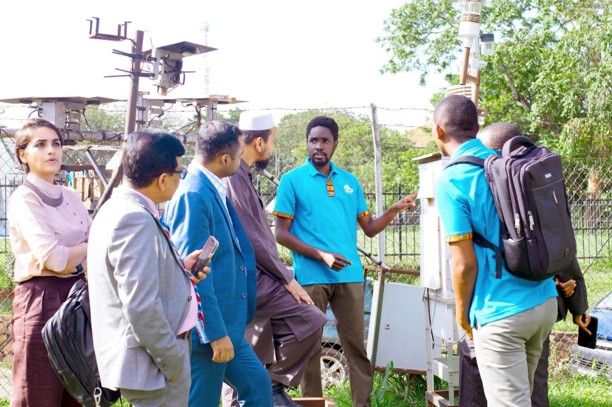
Accurate air quality data depends on having access to local data from reference-grade monitors, but many African cities lack access to these stations due to their high cost and maintenance requirements. To close this gap, we are using machine learning models to develop local calibration for large-scale sensor networks. The models are trained to periodically sharpen the raw sensor data to match the reference-grade data.
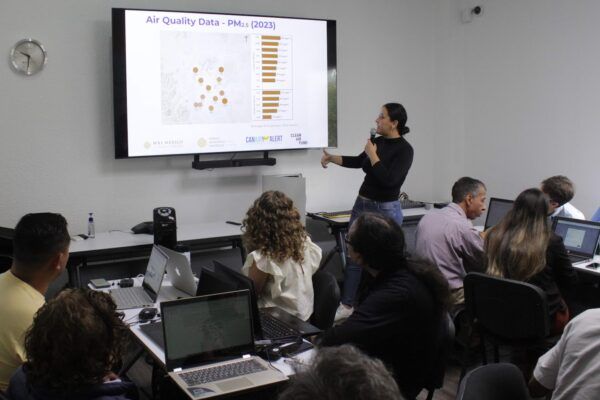
By combining machine learning and geospatial intelligence in an open-access digital tool, cities can find the optimal locations to place their sensors and effectively calibrate them to their local conditions. The tools also allow network managers to test and analyse multiple sensors simultaneously. These open-source tools, paired with step-by-step user guides and city-official training, are empowering local governments to design and maintain robust monitoring networks without requiring advanced technical skills.
The project is scaling up this localised calibration model, with a digital calibration interface openly available, allowing more cities and organisations, including those without direct access to high-grade reference stations, to calibrate their low-cost sensor data effectively.
Prof. Engineer Bainomugisha, AirQo Project Lead
A public digital registry of reference monitors is also being developed to identify reference-grade monitors and corresponding metadata across the continent. This will enable cities and researchers to identify local calibration partners and validate their data more effectively. By openly sharing information on existing reference instruments, the registry will catalyse collaboration within the community of actors, including cities and researchers, toward strengthening sensor data integrity in Africa.
Personalised air quality information to create awareness
Expanding access to air quality data is a critical first step, but it does not always translate to awareness or action. Research increasingly shows that people are more likely to engage with air pollution when information is localised, personalised and directly linked to health. Yet in many cities, air quality data remains difficult to interpret or disconnected from people’s daily experiences. Creating more personalised, accessible ways of sharing air quality information is a critical step in turning data into action.
The AirQo mobile app provides real-time air quality updates across Africa and is being enhanced to include personalised forecasts to residents. It will be available in multiple languages, so more people can understand and act on air quality data.
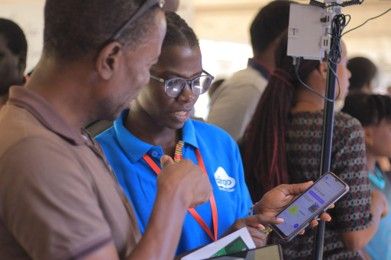
“Our ongoing work in Kampala and Nairobi shows that public awareness about the causes and consequences of air pollution is quite low. Having a robust mobile platform allows the public to more easily assess their own exposure to air pollution in real time, and also allows us to study demand for hyperlocal air quality data,” says Prof Melina Platas, a political scientist from New York University Abu Dhabi. Melina is leading research focused on data-driven citizen engagement in Kampala and East Africa.
By investing in developing smarter tools, initiatives like this can empower local sensor groups and local governments to generate reliable data and drive informed interventions.