Blog 28 July 2026
In Lahore, Pakistan, winter often brings severe smog that blankets the city for weeks at a time. A local doctor described how outpatient visits surge during these months, not only among patients with chronic respiratory diseases, but also among children with persistent coughs, pregnant women facing heightened health risks, and older adults struggling to breathe. Outside her clinic, the effects were visible across daily life: schools shortened hours or closed, outdoor activities were curtailed, and poor visibility disrupted commutes and economic activity.
Although government efforts to address smog intensified considerably in 2025, including expanded monitoring and response measures, severe pollution episodes continued to affect millions of residents. Beyond the immediate health burden, smog affects education, productivity, household incomes, and overall quality of life, imposing social and economic costs that remain only partially measured and insufficiently reflected in policy and investment decisions.
Despite growing recognition of the impacts of air pollution on human health and ecosystems, public investment in air quality remains uneven, and limited measurement and reporting of outcomes weakens the case for scaling up action.
This is a missed opportunity. Air pollution costs economies heavily, yet clean air remains underfunded. The World Bank estimates the economic costs of outdoor air pollution at around 5% of global GDP each year, while only 1% of international development funding between 2019 and 2023 was committed to tackling it.
Understanding the barriers to air quality investment in low- and middle-income countries, where air pollution levels are the highest, is a critical first step toward identifying targeted actions for governments and international financing institutions to unlock and scale up funding.
What are the main barriers to air quality investment?
An analysis conducted this year by the United Nations Development Programme (UNDP) across fifteen low- and middle-income countries, identified nine barriers to investment in air quality, as described in this policy brief. These barriers cluster into four categories:
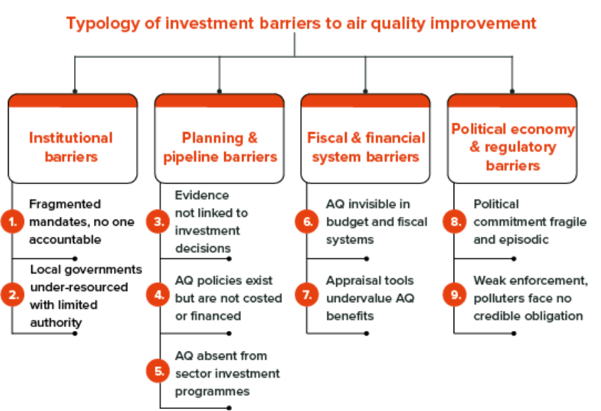
- Institutional barriers include the absence of a clear lead agency on air quality, fragmented responsibilities across government sectors, and limited funding, capacity and authority at the local level.
- Planning and pipeline barriers arise where air quality policies are not costed, linked to implementation and financing plans, or integrated into budgets and sector investments, and where pollution data is not translated into investment-ready evidence.
- Fiscal and financial system barriers stem from public investment tools that overlook the health and productivity benefits of cleaner air, budget systems that do not track air quality outcomes, and misaligned fiscal policies such as fossil fuel subsidies.
- Political economy and regulatory barriers relate to short-term political commitment, weak regulations and enforcement, possible fossil fuel industry interference, and the absence of credible pollution cost signals that would incentivise both polluters and private investment in cleaner alternatives.
Addressing these systemic constraints is essential to unlocking greater public sector financing and enabling more effective, sustained investment in air quality.
What can governments and international financing institutions do to overcome these barriers?
Actions to unlock air quality investment focus on linking evidence, policy, and finance by developing investment-ready analysis, turning plans into costed pipelines, and consistently embedding air quality into public finance and cross-sector decision-making. Reforms such as stronger regulation, economic incentives, and subsidy changes can mobilise private investment and shift behaviour, if properly accompanied by equity protections.
International institutions can scale impact by integrating air quality into sector financing, supporting bankable projects, using concessional funding to reduce risk, and coordinating to strengthen regulatory and investment frameworks.
Building momentum to COP31
As the global climate agenda moves from ambition to implementation, the road to COP31 presents a critical opportunity to elevate air quality as a central pillar of climate and development action.
Emerging evidence from nationally determined contribution (NDC 3.0) submissions highlights growing recognition that clean air is not only a fundamental human right and public health priority, but also a powerful lever for accelerating climate mitigation, advancing sustainable development and unlocking investment.
Through its Climate Promise: Forward initiative, UNDP is supporting countries to strengthen the integration of air quality and super pollutants within NDCs, accelerate the transition away from fossil fuels, develop investment cases, and mobilise sustainable finance for priority interventions. For example, Integrated National Financing Frameworks provide the mechanism for aligning public and private finance with national priorities and strengthening the financing of air quality and climate objectives. It can help to translate commitments into implementation through support for city and subnational governments, urban planning, project preparation and capacity development.
Integrating air quality more systematically into climate finance frameworks can unlock new investment opportunities, deliver significant health benefits and support a just and sustainable transition – offering cities like Lahore a pathway toward cleaner air and a healthier future.