Blog 27 November 2026
COP31 ended in gridlock and ultimately without agreement, as countries rightly refused a cover text that failed to mention fossil fuels. Amidst the headlines decrying the failure of this year’s negotiations, we saw glimmers of progress on areas like super pollutants, with emerging coalitions of the willing stepping up.
That’s why two main developments on clean air action stood out to me: stronger political and philanthropic backing for action on super pollutants – notably with a growing focus on black carbon – alongside a clearer recognition that health concerns can help drive more ambitious climate policy.
Action on super pollutants is an essential part of protecting our climate and improving our health. These short-lived climate pollutants are responsible for nearly half of global warming to date. Several are linked to lung disease and early death.
Progress on super pollutants at COP31
COP31 reflected growing recognition that action on super pollutants, alongside reducing CO2, can deliver benefits four times faster than decarbonisation alone.
At the High-Level Summit on Methane and Non-CO₂ Greenhouse Gases – co-hosted by Brazil, China, the United Kingdom and the COP31 Presidency – more than US$480 million in new philanthropic commitments were announced to accelerate action on methane and other super pollutants. A further US$25 million was announced for the Super Pollutant Country Action Accelerator, which will help seven additional countries with implementation by setting up national units embedded within governments that focus on super pollutant action.
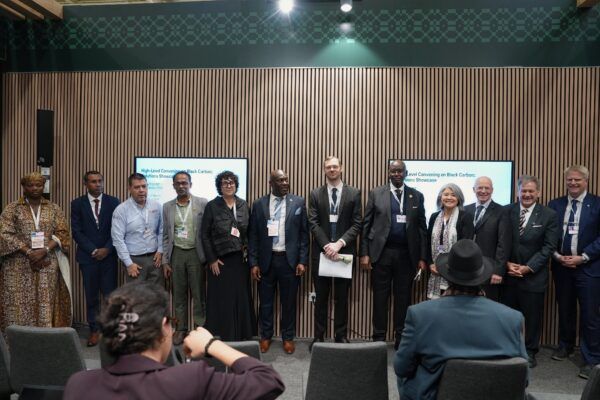
As for black carbon, its impacts on ice and glacier melt drove it up the political agenda. Nepal’s Minister of Foreign Affairs, Shisir Khanal, called for stronger international action on black carbon following the devastating glacier-related flooding his country experienced in August. This call to action emerged from a high-level event with several Asian countries championing action to protect glaciers. Alongside this, the Ministers of Environment from Bangladesh, Chile, Iceland, Monaco and Norway signed a statement drawing attention to the need to preserve the cryosphere and to reduce methane and black carbon emissions.
We also saw an expansion of the Peer Network for Sectoral Action on Black Carbon. Launched at COP30, this year Cambodia, Mexico and Panama joined, expanding the network to 12 countries. The Peer Network is helping member countries drive practical measures across key emitting sectors. For example, Nigeria has included action on agricultural burning and clean cooking in its national climate plan, while Uganda is developing a National Black Carbon Action Plan. We are pleased at Clean Air Fund to support this network with Clima Trust and the Climate and Clean Air Coalition.
But greater political attention has yet to translate into finance at the scale that is needed. Our latest State of Global Air Quality Funding report found that less than 1% of international development funding went to outdoor air quality projects in 2024. For super pollutants specifically, the funding gap remains particularly stark. Primary black carbon funding – where black carbon reduction is an explicit project objective – represented less than 1% of total air quality funding across 2020–2024. Finance explicitly targeting tropospheric ozone also remained negligible.
Growing recognition that health is central to climate action
The UN Climate Change Executive Secretary, Simon Stiell, noted at COP31 that “Health belongs at the heart of climate action.”
It was encouraging that the Climate & Health Funders Coalition announced it has awarded over two thirds of its original $300 million commitment, with a further $150 million committed this year; a sign of growing philanthropic momentum across climate and health.
More than 100 countries are now part of the Alliance for Transformative Action on Climate and Health, and Spain, France, Peru, Tuvalu, Ireland and Barbados launched a Political Declaration on a Healthy Transition committing the health sector to driving action. The declaration frames the move away from fossil fuels not only as a climate necessity, but an opportunity to improve health, strengthen economies and reduce inequality.
That framing is important. Climate negotiations can feel distant from people’s everyday lives, whereas polluted air, extreme heat and fossil fuel combustion have immediate health consequences. In our work at Clean Air Fund, we see how climate action can deliver benefits now, through cleaner transport, healthier homes, more reliable clean energy and fewer illnesses linked to air pollution.
What needs to happen after COP31?
The coalitions of the willing that emerged and grew at COP31 are an important path to progress – especially given how difficult the formal negotiations were – but they are not a substitute for the UNFCCC process and do not remove the need for deep CO2 reductions. That said, the scale of the momentum on super pollutants is a real step-change.
Looking ahead, we want to see:
- Renewed commitment to the COP32 UNFCCC process, with commitments to honour what has previously been agreed on the essential need for a transition away from fossil fuels.
- The growing focus on super pollutants turning from commitments to action, backed by the international finance needed to realise this.
- More countries showing leadership from the health sector and specifically on tackling air pollution to drive progress on both health and climate change.
- The second Global Stocktake should recognise that rapid action on all super pollutants – including black carbon and tropospheric ozone as well as methane – is essential to limit near-term warming while protecting health and the cryosphere. That recognition should translate into stronger national climate plans and policies, greater finance for sectoral solutions from development banks, and measurable implementation by countries.